


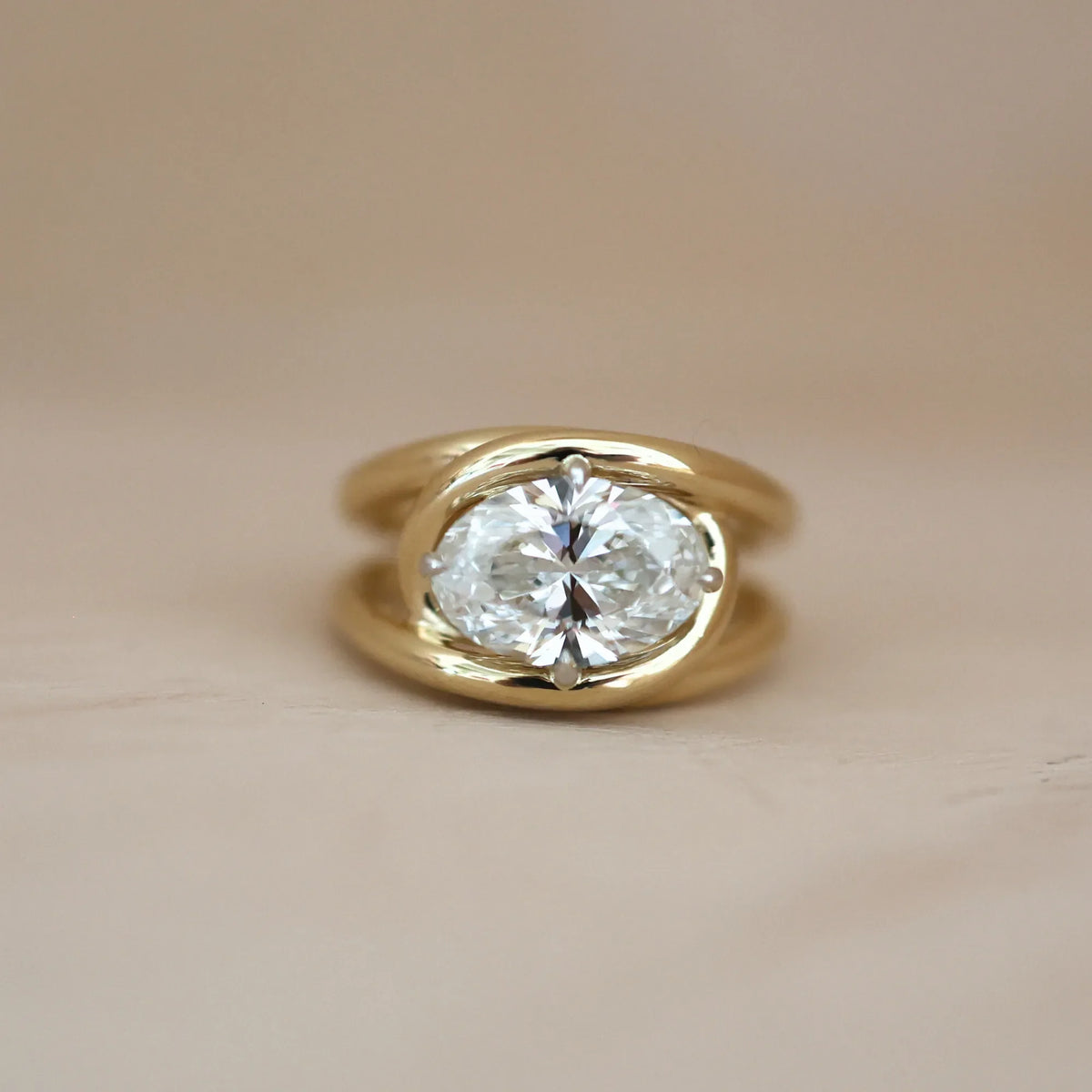
Engagement Ring Trends 2026: Gold, Ovals & Custom Rings
The first thing most people notice about engagement rings in 2026 is that they're smaller. Not cheaper. Smaller. The average center stone now sits right around a carat, and couples are spending the difference on the setting, the metal, or the design instead of on size alone. It's a quiet shift, and it tells you almost everything about where taste is heading this year.
Here's the short version of what engagement ring trends 2026 is built on: warmer metals, softer shapes, stones chosen for how they catch light rather than how big they read across a room, and a growing number of couples who skip the display case entirely and design the ring themselves. Below is what's actually changing, and how to think about it if you're the one shopping.
Yellow gold finally took the lead
For most of the last two decades, white metals ran the show. Platinum, white gold, that cool silvery look. In 2026 that's no longer the default. Yellow gold is the fastest-rising metal for engagement rings — it now accounts for around 39% of US rings in The Knot's 2026 study, more than double its share of five years ago. It's not a fringe choice anymore. It's the one people ask for first.
Part of it is warmth. Yellow gold reads soft against skin in a way white metals don't, and it flatters a wider range of complexions. Part of it is that it doesn't need re-plating the way white gold does; what you see is the actual metal, all the way through. And part of it is simply that it looks less like everyone else's ring from 2010.
At Mama Bijoux, nearly the entire collection is 14k yellow gold, so this one lands close to home. There's a reason: 14k holds up to daily wear better than higher-karat gold, and the color is rich without being brassy. If you want a yellow gold engagement ring you'll actually wear every day, through gardening and dishes and twenty years of it, 14k is the honest answer.
Oval is closing the gap on round
Round has been the default engagement ring shape for roughly a hundred years. In 2026 the oval pulled almost even with it — The Knot's latest study puts round and oval within a single point of each other, the closest that race has been in decades. In a category that changes slowly, that's a genuinely big shift.
The appeal is practical as much as aesthetic. An oval carries its carat weight across a longer face, so it looks larger than a round stone of the same weight. It elongates the finger. And it has fewer sharp points than a marquise or a pear, which means fewer spots to snag. That combination is why it keeps climbing while round holds steady.
You'll also see toi-et-moi settings turning up more than they used to: two stones sitting side by side, one for each person. It's a French style with real history (Napoleon reportedly gave Joséphine one), and it reads romantic without reading fussy. Volume on it is smaller than the headlines suggest, but as a design idea it keeps showing up in consultations.
Lab-grown is now the majority, with a caveat worth understanding
Lab-grown diamonds now make up roughly 61% of center stones sold in the US, up more than 200% since 2020. Whatever you think of them, that's no longer a niche; it's most of the market.
The pitch is straightforward. A lab-grown diamond is chemically and optically the same as a mined one, with the same hardness, the same fire, everything a jeweler's loupe can read, for a fraction of the price. That's what's driving the shift, and it's why so many couples now put the savings toward a bigger stone, a better setting, or the wedding itself.
The caveat is resale and long-term value. Lab-grown prices have fallen fast as supply scaled, and a lab stone doesn't hold value the way a fine natural diamond can. If you're choosing a ring as an object to pass down, the kind that means something forty years out, that trade-off is worth sitting with honestly. Neither answer is wrong. They're just different priorities, and a good jeweler should tell you that plainly instead of steering you.
(At Mama Bijoux, every stone is a natural diamond or gemstone. We'll walk you through the difference so you can decide what fits your ring and your reasons. No pressure either way.)
"Quiet luxury" is doing real work here
The smaller-stone trend has a name attached to it now: quiet luxury. Strip away the marketing gloss and it means something specific. People are choosing rings that look like theirs, not like a status update.
That shows up as thinner bands, lower settings that sit close to the finger, bezels instead of tall prongs, and stones sized to a real hand rather than a photograph. A 0.95-carat oval in warm yellow gold, set low so it doesn't catch on a coat sleeve, is a very 2026 ring. It's confident without announcing itself. And it tends to age better than whatever was loudest the year you bought it.
The custom engagement ring stopped being a splurge
The clearest signal in all of this: more couples are designing the ring instead of buying it off a shelf. Searches for "custom engagement ring" run into the tens of thousands a month, and the intent behind them is different from someone browsing a case. These are people who already know, roughly, what they want, and can't find it standing in a store.
A custom engagement ring isn't the extravagance it sounds like. Often it costs about the same as a comparable ready-made ring, because you're paying for the stone and the gold, not for a name stamped inside the band. What you get instead is a ring built around one person: the shape her hand actually is, the way she'll wear it, the stone that means something to the two of you.
That's the whole idea at Mama Bijoux. Katie Miller designs each piece in the Newport Beach atelier, in person, starting with a conversation rather than a catalog. You bring the story, whether it's an inherited stone, a color that matters, or a shape you keep coming back to, and she sketches from there. It's made to order, in 14k or 18k gold with natural diamonds and gemstones, and it's the kind of ring most people end up treating as an heirloom, because it was made to be one.
If a yellow gold engagement ring in an oval or a toi-et-moi setting is where 2026 is heading, that's a design conversation, not a shopping trip. And once the ring's on, the next question is usually the band. A plain or shaped wedding band that stacks alongside it is the natural next piece.
Ready to start? The custom design process begins with a single appointment in the Newport Beach studio.
FAQ
What are the biggest engagement ring trends for 2026?
The biggest engagement ring trends for 2026 are yellow gold overtaking white metals as the most-requested engagement ring metal, oval-cut stones drawing nearly even with round for the first time in decades, a "quiet luxury" move toward smaller center stones around a carat, lab-grown diamonds making up roughly 61% of US center stones, and a rise in custom-designed rings over ready-made ones.
Is yellow gold in style for engagement rings in 2026?
Yes. Yellow gold is the fastest-rising engagement ring metal in 2026, accounting for around 39% of US rings, more than double its share of five years ago. It's favored for its warmth against skin, its durability in 14k form, and the fact that it doesn't require re-plating like white gold does.
Are oval engagement rings still popular in 2026?
Oval engagement rings are more popular than ever in 2026. The oval cut has drawn nearly even with the round cut, which has led the category for about a century — The Knot's 2026 study puts the two within a single point of each other. Ovals look larger than a round stone of the same carat weight, elongate the finger, and have no sharp points to snag.
How much does a custom engagement ring cost?
A custom engagement ring often costs about the same as a comparable ready-made ring, because the price reflects the stone and the metal rather than a retail markup. At Mama Bijoux, each ring is designed to order in 14k or 18k gold with natural diamonds and gemstones; final cost depends on the stone, the metal, and the design.
Should I choose a lab-grown or natural diamond for my engagement ring?
Lab-grown and natural diamonds are chemically and optically identical, so both look the same to the eye. Lab-grown stones cost significantly less, which is why they now make up the majority of the US market. Natural diamonds tend to hold long-term value better, which matters more if you plan to pass the ring down. The right choice depends on whether you're prioritizing size and price or long-term value.
What is a toi-et-moi engagement ring?
A toi-et-moi ("you and me") engagement ring features two stones set side by side, one representing each partner. It's a French style with historical roots — Napoleon is said to have given Joséphine one — and it's seen renewed interest as couples look for designs with personal meaning.
Where can I design a custom engagement ring in Orange County?
Mama Bijoux designs custom engagement rings in its Newport Beach atelier, serving clients across Orange County and Southern California. Designer Katie Miller works with you in person, starting with a consultation, and each ring is made to order in 14k or 18k gold with natural diamonds and gemstones.
Discover more at Mama Bijoux
Leave a comment
This site is protected by hCaptcha and the hCaptcha Privacy Policy and Terms of Service apply.