


How to Layer Necklaces for Fall/Winter 2026: A Stacking Guide
Sweater weather changes the math on necklaces. A single fine chain that looked right against bare skin in July disappears under a mockneck in November. So you add a second. Then a third sits a little longer, catching the light where the knit ends, doing the work the collarbone used to do.
That's the appeal of layering necklaces in colder months: higher necklines give you a canvas, and a stack reads as considered rather than busy. Here's how we build one at our Newport Beach atelier, plus the rules worth keeping and the ones worth breaking.
How do you layer necklaces?
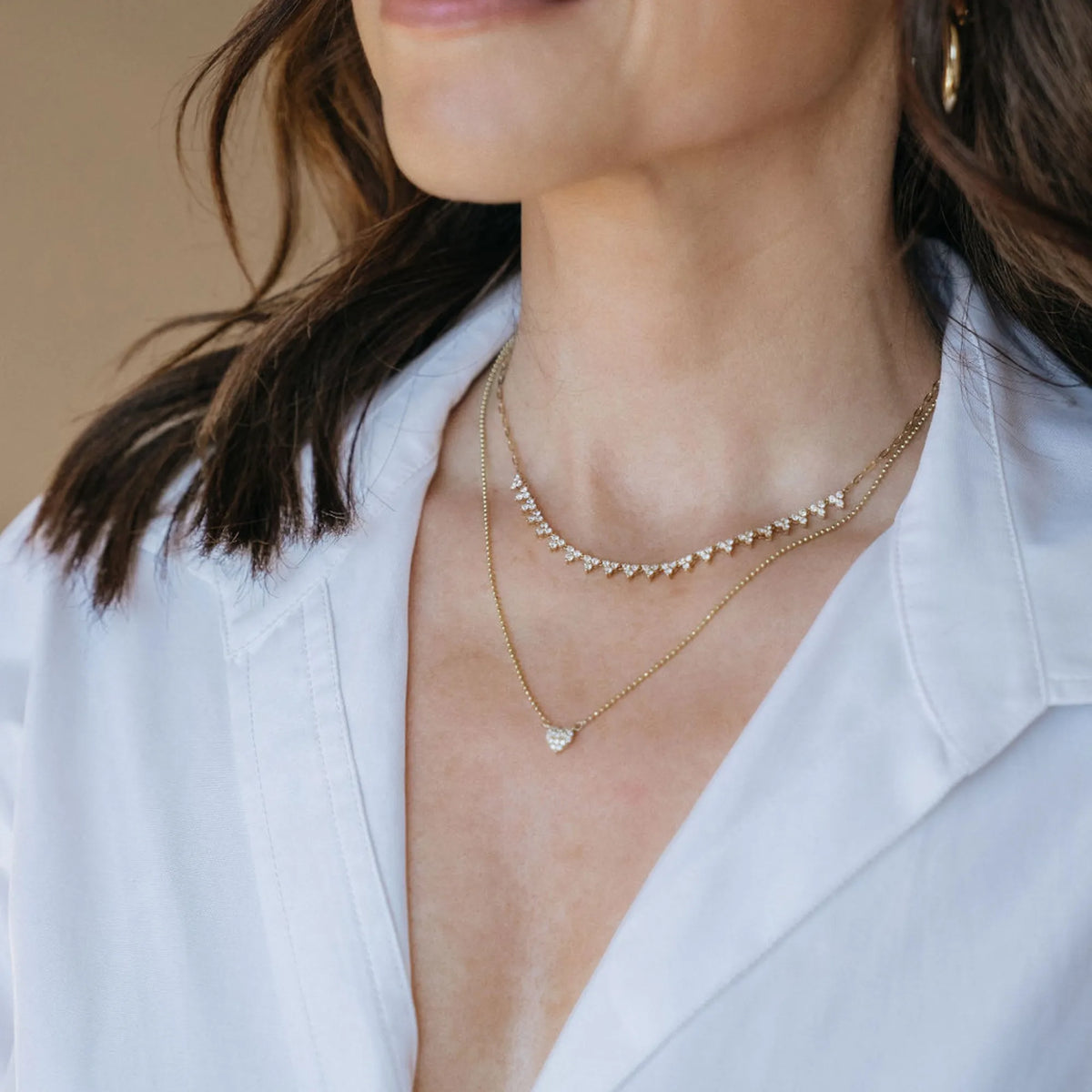
Start with three chains at staggered lengths, roughly two inches apart, so each one is visible and none hides behind another. Mix chain textures — a fine cable, a bolder link, one with a pendant. Let a single metal dominate, and anchor the group with one focal piece near the bottom. That's the base formula; everything else is refinement.
What's the rule for layering necklaces?
There isn't one rule. There are five that do most of the work, and once you know them you can ignore the rest.
Stagger the lengths. The reliable increment is about two inches. A 16-inch choker, an 18-inch mid-length, a 20- or 24-inch drop, each length getting its own airspace. Pieces that land too close together read as a tangle, not a layer. Our Dainty Box Chain Necklace makes a good top layer for this reason: it sits high and close, so the chains below it have room to fall.
Vary the chain texture. Three identical cable chains look like you couldn't decide. A box chain, a paperclip link, and a rope chain in the same gold read as one deliberate group. The Itty Bitty Paperclip Chain Necklace and the Mama Bijoux Mini Belcher Chain Necklace pull in opposite directions texturally, which is exactly why they work stacked. Beads push texture further than any chain: the Lime Green Agate Beaded Necklace is polished agate with a 14k gold clasp, smooth and round against the links.
Anchor with a focal point. Every good stack has one piece your eye lands on first, usually the longest. A pendant, a lariat, a graduated line of stones. The Celestial Graduated Diamond Layering Necklace was built for this job — the diamonds step up in size toward the center, so it settles the whole arrangement instead of competing with it. A Diamond Bezel Lariat does the same with a longer, cleaner drop.
Decide on your metals. Mixing metals is fine, good even, but let one carry about 60 to 70 percent of the stack so the mix looks intentional. For layering necklaces, gold is the easy dominant, and 14k or 18k yellow is where our catalog lives. If you're bringing in a warmer or cooler tone, keep it to a single accent piece.
Match the stack to the neckline. A crewneck wants shorter layers that sit above the fabric. A deep V or an open button-down wants at least one long piece to fill the space. Most people skip this rule, and it's the one that decides whether a stack looks styled or accidental.
What's the current trend for layered necklaces?
Two things stand out heading into fall and winter 2026. Search interest in how to layer necklaces is up 53% year over year, which tracks with the studio: more clients building stacks piece by piece rather than buying a pre-made set. And the pieces are getting more textural. Graduated diamond lines, mixed-link chains, and station necklaces are outpacing the plain, uniform chains of the last few years.
Gold stays the center of gravity through the season. Yellow gold reads warm against winter knits and holiday reds, and it photographs better in the low, gray light most of us are shooting in by December. Own one good gold chain and that's your starting point.
Is layering necklaces in style in 2026?
Yes, and for a practical reason it isn't going anywhere: a stack you assemble yourself is personal in a way a single chain can't be. You add a birthstone bead for a daughter, a horseshoe for luck, a Médaille de la Maman for the obvious reason. Each piece marks something. An Engravable Goddess Heart Necklace marks it in words, with a name or a date engraved on the heart. The trend is really just permission to wear all of them at once.
How to layer necklaces without them tangling
Tangling is the reason most people give up on stacking, and it's the most solvable part. Space your lengths properly, since the two-inch rule keeps chains from riding into each other. Offset the clasps by rotating one or two to the front or side so the springs don't catch. And use a piece built to hold the group together: a layering clasp or a swivel-charm chain lets you wear several strands as one and take them off as one. The Oval Link Swivel Charm Holder Chain and the Diamond Spring Clasp Chain Necklace both do this, so the layer you spent five minutes arranging survives being pulled over your head.
Stacking necklaces to buy for the season
If you're building a fall stack from scratch, three pieces get you there:
A fine everyday chain as the top layer: the Adina Reyter 2mm Italian Chain sits high and close.
A textured mid-length with movement: the Mini Trio Diamond & Chain Stacking Necklace adds a little sparkle without shouting.
A focal drop to anchor the bottom: the Diamond Star Layering Necklace or the Celestial Graduated Diamond Layering Necklace.
All three are 14k gold, meant to be worn together and worn daily, and you don't have to buy them at once.
A quick word on stacking rings
The same logic works below the collarbone. To stack rings, vary the widths, keep to one dominant metal, and let one ring, usually a band with a stone, be where your eye goes. Two or three per hand, spread across fingers rather than crowded on one.
Frequently Asked Questions
How many necklaces should you layer at once?
Three is the reliable number for a balanced stack. Two reads clean and minimal; four or more works if the lengths are well staggered and only one piece carries a pendant.
What length necklaces are best for layering?
Stagger in roughly two-inch increments — a common set is 16, 18, and 20 inches, with a 24-inch drop if you want a longer focal layer. A choker plus a mid-length plus a long pendant covers most necklines.
Can you layer gold and silver necklaces together?
Yes. Mixing metals is on-trend, but let one metal hold about 60 to 70 percent of the stack so the combination looks intentional rather than mismatched.
How do you keep layered necklaces from tangling?
Space the lengths at least two inches apart, offset the clasps, and use a layering clasp or swivel-charm chain to wear multiple strands as a single piece.
Are layered necklaces still in style for 2026?
Yes. Interest in how to layer necklaces is up 53% year over year, and the look continues to favor personal, self-assembled stacks over pre-made sets.
Every piece in this guide is made in 14k or 18k gold with natural diamonds and gemstones, built to be layered and worn every day. If you want help assembling a stack that means something specific, a bead for each of your kids or an heirloom worked back in, that's a conversation, not a checkout. Book a studio visit and we'll build it with you.
Discover more at Mama Bijoux
Leave a comment
This site is protected by hCaptcha and the hCaptcha Privacy Policy and Terms of Service apply.