


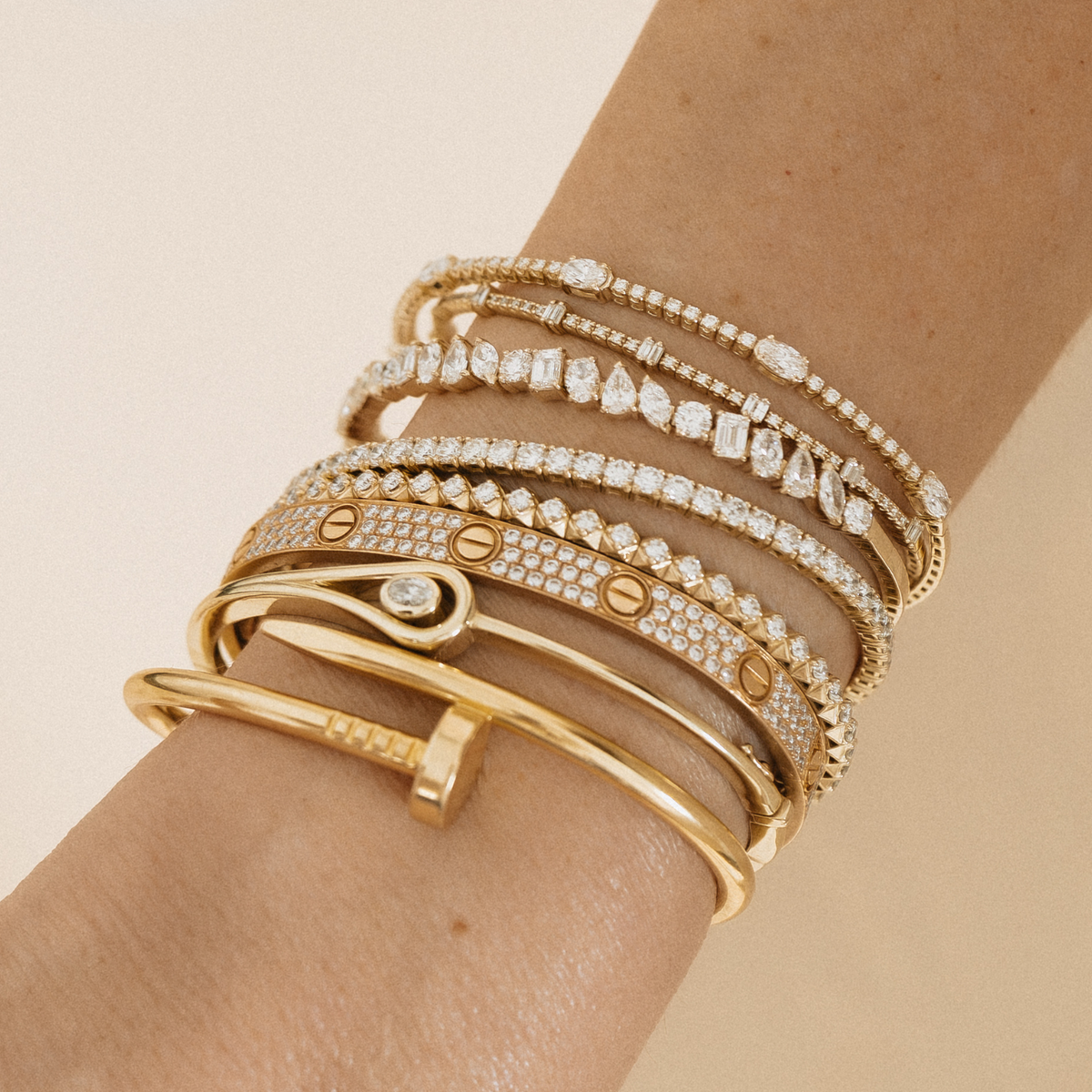
The Flexible Diamond Tennis Bracelet | Mama Bijoux
Diamonds | Mama Bijoux
A flexible diamond tennis bracelet wraps your wrist in a continuous line of diamonds set in a jointed, articulated design that moves with you. No clasp fumbling, no rigid circle fighting your arm. That's what separates a flex bangle from a traditional tennis bracelet, and why it's become the diamond piece people actually wear every day instead of saving for an occasion that never quite comes.
What Makes a Tennis Bracelet "Flexible"?
The original tennis bracelet has been a jewelry staple since the 1980s. Chris Evert lost hers mid-match at the 1987 US Open and stopped play to find it, and that moment gave the category its name. The design is simple: a straight line of diamonds, a clasp, worn on the wrist.
The flexible version keeps the diamonds and rethinks the structure underneath. Each diamond setting connects to the next through a small hinge or wire-wrapped joint, rather than a fixed frame. The bracelet bends. It drapes with the natural curve of your wrist instead of holding a rigid shape against it.
In practice this matters for daily wear. A traditional tennis bracelet can catch slightly when you reach through a sleeve or rest your wrist flat on a desk, a small friction, but one you notice over a full day. A flex bangle settles against the wrist and stays there quietly. You stop noticing it's there, which is exactly right.
The Classic 4 Prong Setting Diamond Flexible Tennis Bangle at Mama Bijoux uses a four-prong setting on each stone, the same configuration as a solitaire engagement ring, where four metal tines hold the stone at the corners and leave as much of the diamond face exposed as possible. What you get is a clean, uninterrupted line of sparkle around the wrist, with as little metal interrupting it as possible.
Diamond Quality: What Actually Matters
You don't need a gemologist's vocabulary to make a good decision. A few specifics are worth knowing before you buy.
Carat weight in a tennis bracelet describes the combined weight of all the stones, not a single one. A bracelet described as "3 total carats" might hold thirty individual diamonds at roughly 0.10ct each. Those smaller stones are cut with the same precision as a large solitaire. The effect on the wrist is the accumulation, the whole line, not any one stone in isolation.
Clarity and color read differently in a bracelet than in a ring. Because you're looking at a continuous row of stones rather than a single focal point, visual consistency across the bracelet matters more than the exact grade of any individual stone. Slight clarity variations are far less visible in a line than they'd be in a prominent solitaire. Natural diamonds carry inclusions and variations that give each stone its own character, and the way light moves differently through each one is part of what makes a bracelet feel like a piece, not a product.
The setting is where diamond meets metal. Four-prong settings hold each stone at the corners with four metal tines, leaving the stone's face as open to light as possible. Bezel settings wrap each stone in a metal collar for more security at the cost of some sparkle. Both hold up to daily wear. The choice comes down to whether maximum light or maximum protection matters more to you.
Wearing It Every Day
Think of it the way you'd think of wearing a good watch.
In 14k yellow gold with secure prong settings, a flex tennis bracelet holds up to a normal day. Typing, cooking, errands, most gym work, the jointed construction bends with your wrist instead of resisting it. It doesn't snag the way a rigid bangle sometimes does, and it doesn't require any conscious adjustment throughout the day.
The care is straightforward. Take it off before pool or ocean swimming, since chlorine and salt accelerate metal wear over time. Wipe it with a soft polishing cloth when it starts looking dull instead of bright. Once a year, have a jeweler check the prong tips. A loose prong caught early is a minor fix. A stone that falls out without you noticing is not.
A word on layering: because a flex bracelet lies flat against the wrist, it works naturally next to a watch or a thin chain bracelet without competing. Most flex bangles weigh between 8 and 12 grams depending on total carat weight, light enough that two pieces together don't feel burdened. And because a closed flex bangle goes on by slipping over the hand rather than requiring one-handed clasp management, you'll actually put it on in the morning. That detail matters more than it sounds.
Sizing and Fit
Women's flexible tennis bracelets typically run from 6.5" to 7.5", with 7" fitting most wrists comfortably.
To find your size: measure your wrist at the narrowest point with a soft tape measure. Add a quarter inch for a close fit, or half an inch if you prefer a little movement. The bracelet should slide freely without pulling, but it should not travel up your forearm when you raise your hand, that's too loose.
The articulated construction gives you more tolerance than a rigid bangle. A bracelet that feels slightly tight in a fixed version often wears noticeably better in a flex version because the links conform to the wrist rather than holding a fixed circle against it. Some wrists prefer a close drape; some prefer a little swing. Both work.
When uncertain: size up for a piece you plan to stack with other bracelets. Size down for one you want to wear close and alone.
Custom or Ready-Made at Mama Bijoux?
Both options are available, and the difference is simpler than people expect.
The Classic 4 Prong Setting Diamond Flexible Tennis Bangle is a finished piece: 14k yellow gold, natural diamonds, four-prong settings on each stone, ready to wear. If you want a flex bangle and you want it now, that is the piece. The diamonds are bright, the proportions are right, and the flex construction is exactly what makes this category worth owning.
Custom is the other path. If you want a specific total carat weight, a different setting style, or an inherited diamond incorporated into the design, Katie Miller works with you directly at the Costa Mesa atelier. The conversation starts with what you actually want to wear, not with a catalog page. Book a consultation here.
Both paths end with the same materials: 14k yellow gold, natural diamonds, handcrafted in our Costa Mesa atelier. Custom takes more time and costs more, and the result is a bracelet that doesn't exist anywhere else because you described what you needed. Browse the full flexible bracelets collection if you want to see the full range before deciding.
Frequently Asked Questions
What is a flexible tennis bracelet?
A flexible tennis bracelet is a diamond bracelet built on an articulated link structure, small hinges or wire connections between each diamond setting, that bends and drapes with the wrist instead of holding a rigid circle. Diamonds run continuously around the wrist, set in solid 14k yellow gold. The "flex" or "flexi" in the name refers to the jointed construction, not any specific metal property.
What is the difference between a flex bangle and a regular tennis bracelet?
A traditional tennis bracelet is a straight line of diamonds with a box clasp that opens and closes. A flexible tennis bangle is closed, diamonds go all the way around the wrist, and the articulated links allow it to bend and move. It goes on by slipping over the hand rather than clasping shut. Most people find it easier to put on one-handed and more comfortable for extended daily wear.
Is a flexible diamond tennis bracelet durable enough for everyday wear?
Yes. In 14k yellow gold with secure prong settings, it holds up to normal daily use well. The jointed construction moves with the wrist rather than resisting it, which reduces the friction points that cause a rigid bangle to catch or wear. Standard care applies: avoid sustained chlorine or saltwater exposure, have prong tips checked annually, polish with a soft cloth when it starts to look dull.
How do I find my tennis bracelet size?
Measure your wrist at the narrowest point with a soft tape measure, then add a quarter to half an inch for comfortable wear. A 6.5" wrist typically fits a 7" bracelet well. If you're between sizes and plan to stack the piece with other bracelets, size up. If you want it worn close to the wrist alone, size down.
Can I get a custom flexible diamond tennis bracelet made at Mama Bijoux?
Yes. Custom flexible tennis bracelets are available through the Costa Mesa atelier in your specified carat weight and setting style. Existing diamonds, including stones from inherited pieces, can be incorporated into the design where appropriate. The process begins with a one-on-one consultation with Katie Miller. Book an appointment here.
Discover more at Mama Bijoux
Leave a comment
This site is protected by hCaptcha and the hCaptcha Privacy Policy and Terms of Service apply.